
What Is The Distance From Dart Board
Ah, the dartboard. That circular, bristled magnet for a bit of friendly competition, a way to unwind after a long day, or perhaps just a backdrop for some lively banter at your local pub. But have you ever found yourself mid-throw, squinting at that distant, unsuspecting circle of cork, and wondering, "What is the official distance from this thing?" It’s a question that often pops up, usually when someone’s just sailed a dart wildly over the top or into the carpet, prompting a collective sigh and a casual, "Alright, what's the rule here?"
Let’s be honest, most of us aren't aiming for Olympic glory in the sport of darts. We're more likely to be aiming for bragging rights over a pint. But even in our casual pursuits, a little bit of knowledge can go a long way. It adds a touch of authenticity, a sprinkle of "informed fun," and might even, dare I say it, improve your game just a tad. So, settle in, maybe grab yourself a beverage of choice, and let’s dive into the wonderfully, surprisingly precise world of dartboard distance.
The Magic Number: It's Not As Arbitrary As You Might Think
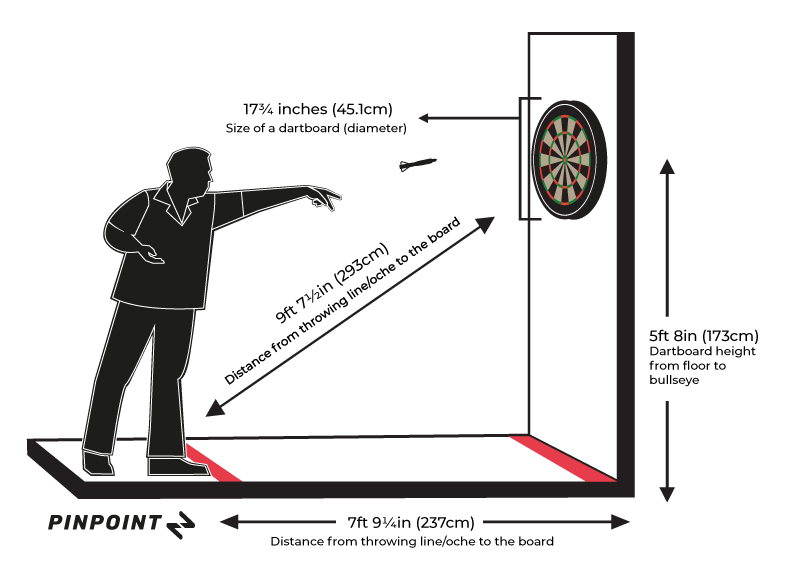
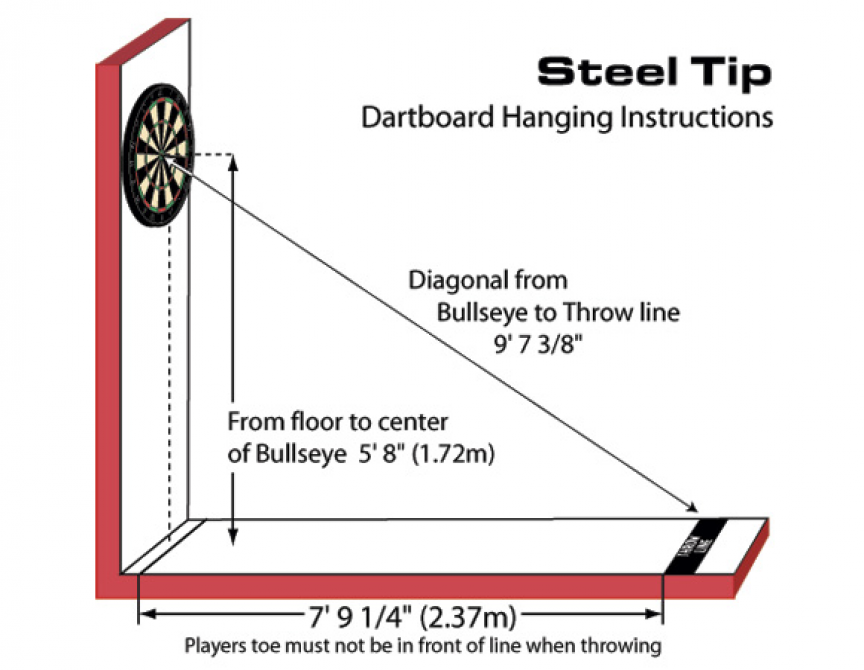
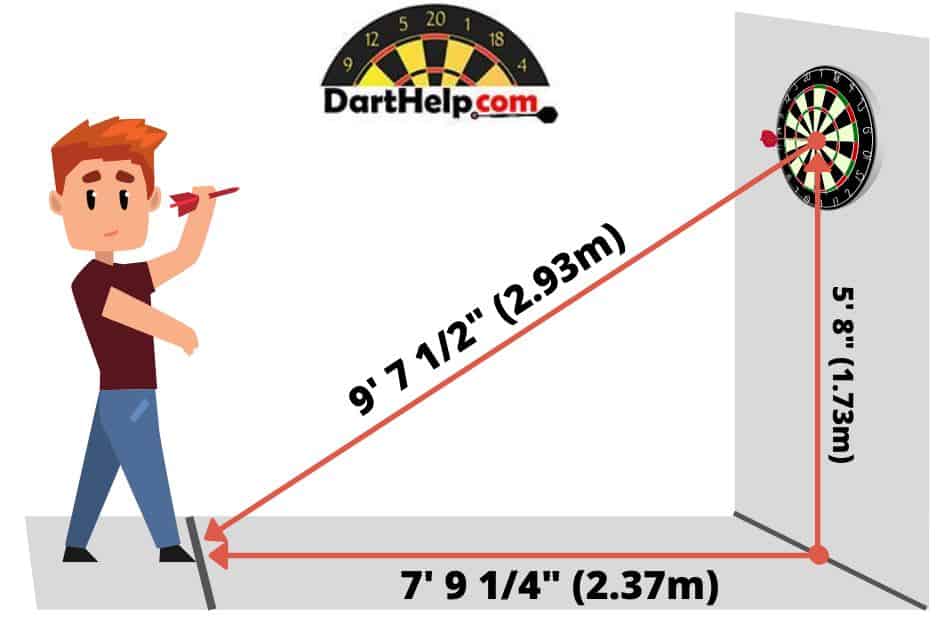
So, what’s the secret sauce? The universally accepted, championship-level distance for a dartboard is 7 feet 9 ¼ inches (2.37 meters) from the face of the board to the face of the oche (that’s the throwing line, for the uninitiated). This isn’t some random measurement plucked from thin air. It’s a carefully considered dimension that balances the player's ability to aim with the dart's trajectory. Too close, and it becomes a game of simply hitting a large target. Too far, and it requires a level of precision that would make a neurosurgeon sweat.
Think of it like this: it’s far enough to demand a bit of skill and finesse, but close enough that a well-thrown dart has a genuine chance of finding its mark. It's that sweet spot that has fueled countless pub leagues, nail-biting finishes, and the occasional, rather embarrassing, miss. It’s the foundation upon which all darting dreams (and frustrations) are built.
Why This Specific Distance? A Little Bit of Science, A Little Bit of History
The 7’9 ¼” measurement isn't just a convention; it has roots in the physics of a dart’s flight. A dart, typically weighing around 20-25 grams, travels through the air with a predictable arc. This distance allows for a natural descent, giving the player a chance to account for gravity and release the dart at the optimal point for accuracy. It’s a dance between the thrower's muscle memory and the dart's aerodynamic properties.
Historically, the sport of darts has evolved significantly from its humble beginnings. While the exact origins are debated – some say Roman soldiers played a precursor with short javelins, others point to medieval archers practicing indoors during inclement weather – the modern game solidified its rules and dimensions over time. The distance we use today is a refinement that ensures fair play and a challenging yet achievable experience for players of all levels. It's a testament to how even simple-looking games have their own intricate lore and measured evolution.
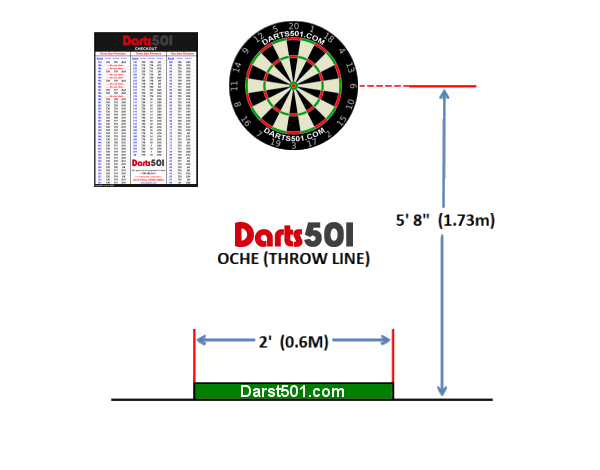
It's interesting to note that while the throwing distance is standardized, the height of the dartboard is also crucial. The bullseye should be 5 feet 8 inches (1.73 meters) from the floor. This ensures a consistent aiming point, preventing players from having to stoop or reach excessively, which would naturally affect their throw. Imagine trying to play basketball if the hoop height varied wildly! The same principle applies here.
Bringing the Pub Home: Setting Up Your Own Dartboard
So, you've been inspired. You've seen the pros on TV, the lightning-fast throws, the triumphant cheers when someone nails a treble 20. And you’ve thought, "I could do that!" Well, maybe not that fast, but you can certainly bring a slice of that darting joy into your own home. Setting up a dartboard is surprisingly straightforward, and getting the distance right is key to making it feel authentic.
First, you'll need a dartboard, of course. The most common are bristle boards, made from sisal fibers. These are great because they "heal" themselves when you pull the darts out, and they offer good grip. Then, you need a way to mount it. A wall mount is the most common, but there are also stand-alone cabinets that look rather dapper.
Now, for the crucial part: the distance. The easiest way to measure is to have a tape measure. Stand your dartboard where you want it, ideally on a wall that can handle a few errant darts (or invest in a dart backboard – a true lifesaver for your walls!). Then, take your tape measure and hook it onto the face of the dartboard. Stretch it out to where your feet will be when you’re throwing. Mark that spot as your oche. Ideally, you want that measured distance of 7 feet 9 ¼ inches.
Practical Tip: Don't have a tape measure handy? No problem! If you have a standard-sized door, the width is often around 30 inches. A quick estimation could be about three door widths plus a little extra. It’s not perfect, but for a casual game, it’s a good starting point. Or, use the length of a standard ruler multiple times. Consistency is more important than absolute perfection for a home setup.

Fun Fact: Many professional dart players have a specific stance and throwing motion that they’ve honed over years. The distance allows them to leverage their body weight and arm mechanics for maximum power and accuracy. It’s a beautiful synergy of sport and biomechanics!
Making It Official (or Just More Fun)
If you’re serious about getting the setup right, you can invest in a dedicated dartboard mounting kit that often includes a spirit level and even a pre-marked oche strip. This elevates your home dart setup from "just for fun" to "seriously fun."
Consider your environment. Do you have enough space behind the dartboard for the darts to land without hitting anything important? Are there windows or valuable artwork that might be at risk? Safety first, always! A good backboard or dart surround is a wise investment, not just for your wall, but for your peace of mind.
And what about the lighting? Good lighting is essential for accurate throws. You don't want to be squinting in dim light, trying to decipher the difference between a 19 and a 20. Aim for even, bright lighting that illuminates the entire board.
Beyond the Pub: Dartball and Other Variations
While the classic pub game of 501 or Cricket is what most people think of, the spirit of darts extends beyond the traditional board. Have you ever heard of Dartball? It’s a fascinating hybrid sport, particularly popular in some American communities, that combines elements of baseball with darts. Players throw darts at a special dartboard that resembles a baseball diamond, with different sections representing strikes, balls, and hits.
The distance in Dartball might vary slightly depending on the league or specific rules, but the principle of a standardized throwing line remains. It’s a testament to how the core mechanics of throwing a dart can be adapted into entirely new and engaging games. It’s a reminder that the distance from the board isn't just about a single sport; it’s about the physics of projection and the human desire for a well-aimed shot.
Cultural Nugget: In the UK, dartboards are practically a national treasure. They’re found in nearly every pub, a focal point for social gatherings and fierce (but friendly) rivalries. The sounds of darts hitting the board, the clinking of glasses, and the shouts of "One hundred and eighty!" are as much a part of the British pub experience as fish and chips.
A Global Perspective
While the 7’9 ¼” is the standard for most professional and organized play globally, it’s worth noting that casual play can be a bit more relaxed. If you’re playing with friends in your backyard and the oche line is a bit fuzzy, don’t sweat it too much. The most important thing is to have fun and keep the game moving. However, if you’re looking to replicate the authentic feel, sticking to the official measurement is the way to go.
Think about how different sports have their specific dimensions. A basketball court, a football field, a tennis court – all have meticulously defined boundaries and measurements. Darts is no different. It’s this attention to detail that allows for standardized competition and the development of true mastery.
The Zen of the Throw: More Than Just Distance
So, we know the distance. We know the height. But what does it all mean for our casual dart-throwing endeavors? It’s more than just hitting a number; it’s about the ritual. It’s about stepping up to the oche, taking a deep breath, visualizing the shot, and releasing. It’s a moment of focus in a world that often demands our attention in a thousand different directions.
When you're setting up your own board, taking the time to measure correctly imbues that act of playing with a little more significance. It's a nod to the tradition, a gesture of respect for the game. Even if you're just playing for the sheer joy of it, understanding the standard distance adds a layer of appreciation for the skill involved.
Personal Reflection: Sometimes, I find myself overthinking things. I’ll worry about the perfect grip, the ideal follow-through, the exact angle of my wrist. But then I remember that casual dart game with friends, where the distance might have been a little off, the lighting imperfect, but the laughter and camaraderie were absolutely spot on. The distance from the dartboard, while important for the game’s structure, is ultimately just one element. The real magic lies in the shared moments, the friendly competition, and the simple pleasure of tossing a few darts. It’s a small reminder that in life, as in darts, it’s often the connection and the effort that matter most, even if the aim isn't always perfect.
So, the next time you’re at the dartboard, whether it’s at home or at your favorite haunt, take a moment to appreciate that 7 feet 9 ¼ inches. It's a measurement that bridges the gap between a casual pastime and a competitive sport, a small detail that contributes to a world of fun and friendly rivalry. And who knows, maybe with a little practice and the right distance, you’ll be hitting those trebles like a pro in no time.