
What Is A Zero Error In Physics Gcse

Right then, imagine you're about to embark on a super-duper exciting adventure into the world of GCSE Physics. You've got your trusty ruler, your trusty stopwatch, your trusty this, your trusty that – all ready to measure things. But hold on a sec! Before we launch into measuring the speed of a runaway hamster or the bounce height of a super-bouncy ball, there's a sneaky little creature lurking in the shadows, ready to mess with our perfectly planned experiments. This little mischief-maker is called a zero error. Don't let the fancy name fool you; it's actually a bit of a prankster!
Think of it like this: you're setting up a race. You've got your starting line, your finish line, and your stopwatch, all lined up beautifully. But what if, just before the race starts, you accidentally nudged the stopwatch a tiny bit, so it wasn't exactly at zero? Maybe it was at, say, 0.5 seconds. So, when the runner crosses the finish line, your stopwatch would say they took 10 seconds, but in reality, they only ran for 9.5 seconds! That extra 0.5 seconds that your stopwatch was already ticking away from the start? Yep, that’s your zero error in action!
In GCSE Physics, we deal with loads of different measuring tools, from your bog-standard ruler to more sophisticated gizmos like ammeters (for measuring electric current) and voltmeters (for measuring electrical voltage). Each of these instruments, bless their metallic hearts, can sometimes have a tiny quirk. They might not be perfectly calibrated to show exactly zero when they're supposed to.
Let's take a ruler, for instance. You know how some rulers have that little bit at the very start, maybe a few millimetres that don't have any markings? Sometimes, the first actual measurement mark isn't precisely at the very edge. If you're trying to measure something really small, like the thickness of a single strand of your amazing hair (which, by the way, is a surprisingly challenging task!), and you start your measurement from the very edge of the ruler instead of the first clear marking, you're introducing a zero error. It’s like trying to measure a whisper with a megaphone – not ideal!
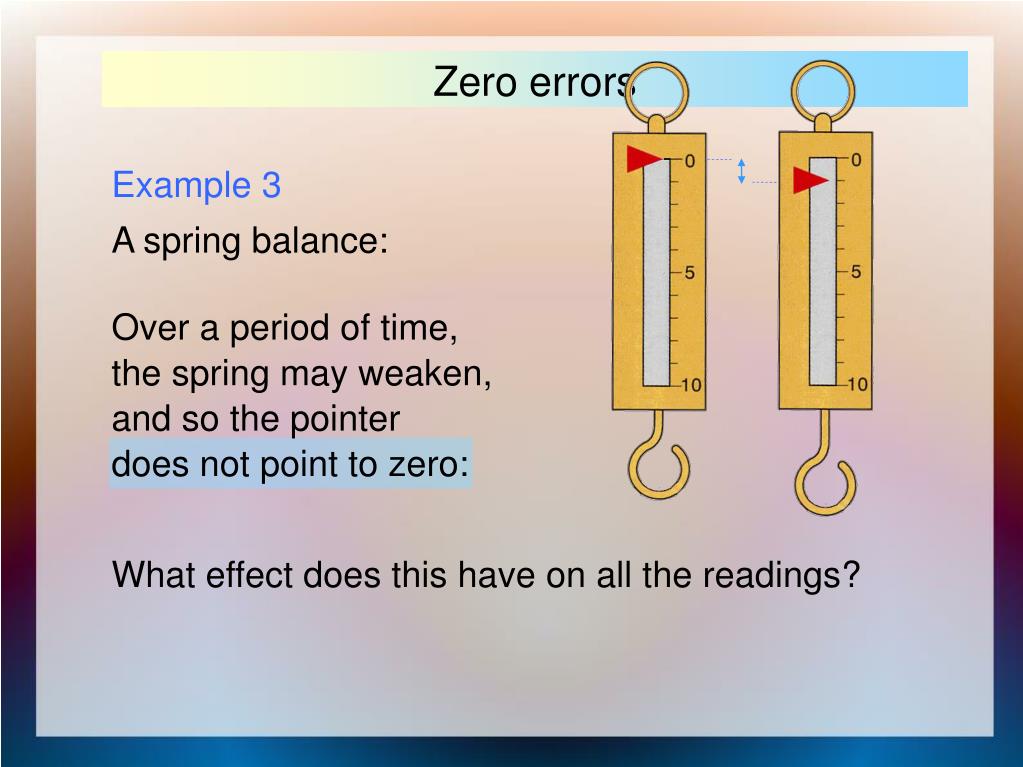
Or consider a spring balance. You know, those things you use to weigh stuff, where the little pointer goes up a spring? If you hang it up and the pointer doesn't point exactly at the '0' mark when there's nothing attached, then you've got a zero error. If you then hang a mysterious, invisible object on it, and the pointer goes up to 10 Newtons, but you knew it was already at 2 Newtons to begin with, then your invisible object actually only weighs 8 Newtons! The extra 2 Newtons that the spring was already showing? That’s the pesky zero error!

So, why is this whole zero error thing so important in GCSE Physics? Well, because we're all about getting the most accurate, most reliable results possible. We want to know the real speed of that hamster, the true voltage of that battery, the actual mass of that mysterious substance. If our measuring tools are already a bit "off" from the get-go, our results will be too. It's like trying to bake a cake with a wonky oven – things are just going to turn out a bit… askew. And in science, we aim for precision, not accidental artistic interpretation of measurements!
"A zero error is like a tiny, invisible gremlin whispering slightly wrong numbers into your measuring device. We need to send that gremlin packing!"
The good news is, dealing with a zero error is usually pretty straightforward. Often, your teachers will show you how to check for it before you even start measuring. For something like a stopwatch, you just make sure it's reset properly to zero. For a ruler, you might start measuring from the first clear marking instead of the edge. And for things like spring balances or electronic scales, you often have a button to press that says 'Tare' or 'Zero' – which is basically telling the device, "Hey, this is now your zero point, forget whatever you thought before!" It's like hitting the reset button on your own brain before a big exam.
Sometimes, a zero error might be a constant amount. This means it's the same every single time you measure. In these cases, you can usually just subtract or add that error from your final reading. It’s like knowing your friend always adds an extra "um" to every sentence they say, so you just mentally filter it out. For other, more fiddly errors, it gets a bit more involved, but for GCSE level, the focus is usually on understanding the concept and knowing how to identify and correct the common ones.
So, next time you're in your GCSE Physics lab, armed with your protractor and your goggles, remember our little friend, the zero error. It's not a big, scary monster, but a small, easily overlooked detail that can make a big difference to your results. By being aware of it and knowing how to deal with it, you're taking a massive step towards becoming a brilliant young scientist, making sure your measurements are as accurate and as awesome as possible. You’ve got this!