
What Does The Step Up Transformer Do

Ever found yourself staring at a gadget, a trusty old appliance, or maybe even dreaming up a wild invention, only to realize its power needs don't quite match what your wall socket is offering? Yeah, me too! It’s like trying to fit a square peg into a round hole, but with electricity! But fear not, my fellow tinkerers and curious minds, because there’s a superhero in the world of electronics that swoops in to save the day. It’s called a step-up transformer, and trust me, it’s way cooler than it sounds!
So, what exactly is this magical device? Think of it as an electrical matchmaker. You’ve got one voltage looking for another, and the step-up transformer is the charming Cupid that makes it happen. It’s a pretty simple concept, really. It takes a lower voltage, like the kind that comes out of your average wall outlet (say, 120 volts), and steps it up to a higher voltage. Boom! Suddenly, your device that craves more juice is singing a happy tune.
Why would you ever need this? Well, imagine you’ve got this amazing, vintage amplifier that needs 240 volts to really belt out those classic rock anthems. But your house? It’s only supplying 120 volts. Without our friendly step-up transformer, that amp would just sit there, sad and silent. Kind of a bummer, right? This little gizmo makes sure that your dreams of perfectly powered audio don’t get lost in translation.
Or maybe you’re an aspiring inventor, cooking up a contraption that requires a bit of a voltage boost to really get going. Perhaps it’s a super-powered robot arm, or a device that can wirelessly charge your phone from across the room (we can dream, can’t we?!). Whatever your brilliant idea, the step-up transformer is your trusty sidekick, ensuring your creation gets the electrical encouragement it needs to thrive.
It's All About Coils!
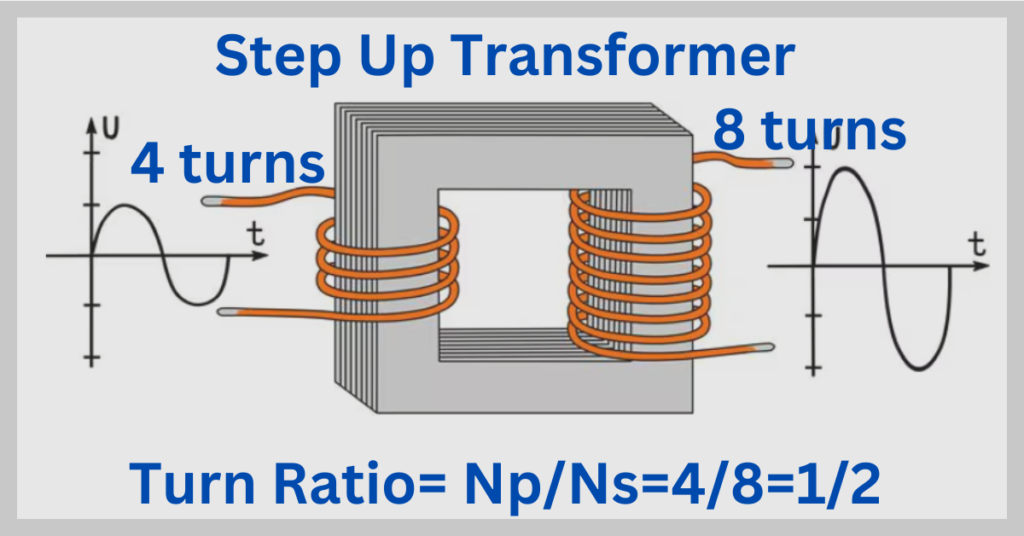
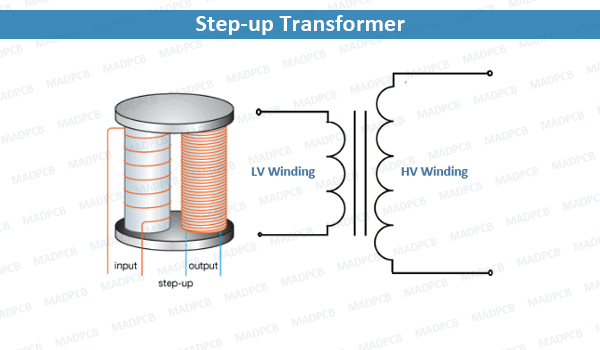
Now, for a tiny peek under the hood (don't worry, it's not complicated, I promise!). The magic of a transformer lies in two coils of wire, usually made of copper, wrapped around a common iron core. Think of them as a pair of dancing partners, their movements influencing each other. One coil is the “primary” coil, where the incoming, lower voltage electricity enters the stage. The other is the “secondary” coil, where the new, higher voltage electricity exits.

Here's the sneaky part: the number of turns on these coils is the secret sauce. The secondary coil has more turns of wire than the primary coil. When the alternating current (AC) flows through the primary coil, it creates a changing magnetic field. This magnetic field, like a whisper traveling through the iron core, induces a voltage in the secondary coil. And because there are more turns in the secondary coil, the voltage it produces is higher than the voltage that went in.
It’s like a game of tug-of-war, but with magnetism and electricity! More turns means more "pull" on the electrical energy, resulting in a bigger voltage output. Isn’t that neat? The universe is just full of these clever little tricks!
Making Life Easier (and Louder!)
So, how does this translate into making your life more fun? Oh, let me count the ways! For starters, it opens up a whole world of possibilities for hobbyists and DIY enthusiasts. Want to power that fancy projector for your outdoor movie nights? Need to run that specialized industrial tool you found at a flea market? A step-up transformer can be your ticket to a more exciting, hands-on experience. You’re not limited by the standard voltage anymore; you’re empowered to explore.

Think about it: you can find amazing vintage equipment from other countries that operates on higher voltages. Instead of just admiring it from afar, a step-up transformer lets you bring those treasures home and actually use them. Imagine the unique sounds you can create with a European synth or the stunning visuals from a Japanese CRT monitor! It’s a fantastic way to connect with different cultures and eras through the lens of technology.
And let’s not forget about the sheer joy of bringing a seemingly useless old piece of tech back to life. It’s incredibly satisfying to see something that was collecting dust suddenly humming with power, all thanks to a little bit of electrical engineering know-how and the humble step-up transformer. It’s like giving an old friend a new lease on life!
Even for everyday situations, it can be a lifesaver. Maybe you’re traveling abroad and want to use your American-bought hair dryer or curling iron, which typically requires 120 volts, in a country that uses 240 volts. A step-up transformer (or more accurately in this case, a step-down transformer, but the principle is similar!) can be your travel companion, ensuring your hair looks fabulous no matter where you are. Though, you need to be careful with what you plug in; some appliances have specific voltage requirements that need careful checking!
It’s also about efficiency. Sometimes, transmitting electricity over long distances at lower voltages is inefficient, leading to power loss. By stepping up the voltage for transmission and then stepping it back down for use, we can send electricity further and with less waste. So, even when you’re not directly interacting with one, step-up transformers are quietly working behind the scenes, making our modern lives possible and more sustainable.
Beyond the Basics: A World of Possibilities
The world of transformers is vast and fascinating. Step-up transformers are just one piece of the puzzle. There are also step-down transformers (which do the opposite, lowering the voltage) and isolation transformers (which provide electrical isolation for safety). Each plays a crucial role in how we generate, distribute, and use electricity.
Understanding these concepts, even at a basic level, can demystify the technology that surrounds us. It’s empowering to know how things work, to be able to diagnose a simple electrical issue, or even to embark on more ambitious projects. Think of the confidence boost you’ll get! You’ll start looking at your appliances and thinking, “Aha! I know how you tick!”
So, the next time you encounter a device that needs a little extra oomph, or you’re dreaming up your next grand invention, remember the humble step-up transformer. It’s not just a piece of metal and wire; it’s a gateway to new possibilities, a tool for innovation, and a silent hero in the symphony of electricity that powers our lives.
Don’t let the technical jargon intimidate you. Dive in! There are tons of resources online, from simple diagrams to detailed explanations. Explore the physics behind it, learn about different types of transformers, and see how they are used in everything from your phone charger to massive industrial machinery. You might just discover a passion you never knew you had. And who knows, with the knowledge of a step-up transformer in your arsenal, you might just be the one to invent the next big thing! So go ahead, get curious, and step up your learning game. The world of electricity is waiting to be explored, and it’s full of electrifying fun!