
Open Door Policy: Definition (history & Government)

A Potluck Party Gone Wild (and How Diplomacy Stepped In)
Imagine you're at the world's most amazing potluck. There’s a dazzling array of dishes, but then a few early birds start hogging all the best stuff. They draw invisible lines around the jumbo shrimp, the gourmet pizzas, whispering, "This section is mine!" Pretty rude, right?
Well, something similar, but on a much grander and more serious scale, was happening over a century ago in a magnificent country called China. This ancient land was like the world's most incredible treasure chest, brimming with exotic goods, vast markets, and a rich culture everyone wanted to access.
Instead of sharing, several powerful European countries and Japan began to carve China into their own "spheres of influence." They were like guests at the potluck, each claiming a slice of the main dish, setting up exclusive little clubs within China's borders.
The Uninvited Guest Who Opened Doors
The United States, then a rising global player, watched this situation unfold with growing concern. We were a bit late to this particular party, but we definitely wanted a piece of the trading action. The problem was, these other countries were setting up their own exclusive shops, making it incredibly difficult for American businesses to get a fair shake.
It was like showing up to the potluck and finding all the good dishes already claimed, with velvet ropes around them. But instead of throwing a tantrum, Uncle Sam had a clever idea, thanks to a very smart cookie named Secretary of State John Hay.
He wasn't one to bash down doors or start a fight; Hay preferred a more diplomatic, thoughtful approach. He looked at the situation and thought, "There has to be a fairer way for everyone to enjoy this fantastic 'potluck' without completely ruining it for the host, China itself."

Hay's Big Idea: The "Open Door" Letters
In 1899, John Hay sent out a series of diplomatic notes, essentially very polite but firm letters, to all the major powers involved. These weren't demands, but more like a revolutionary idea wrapped in elegant diplomacy. He basically asked, "Hey guys, how about we agree to keep the door open for everyone?"
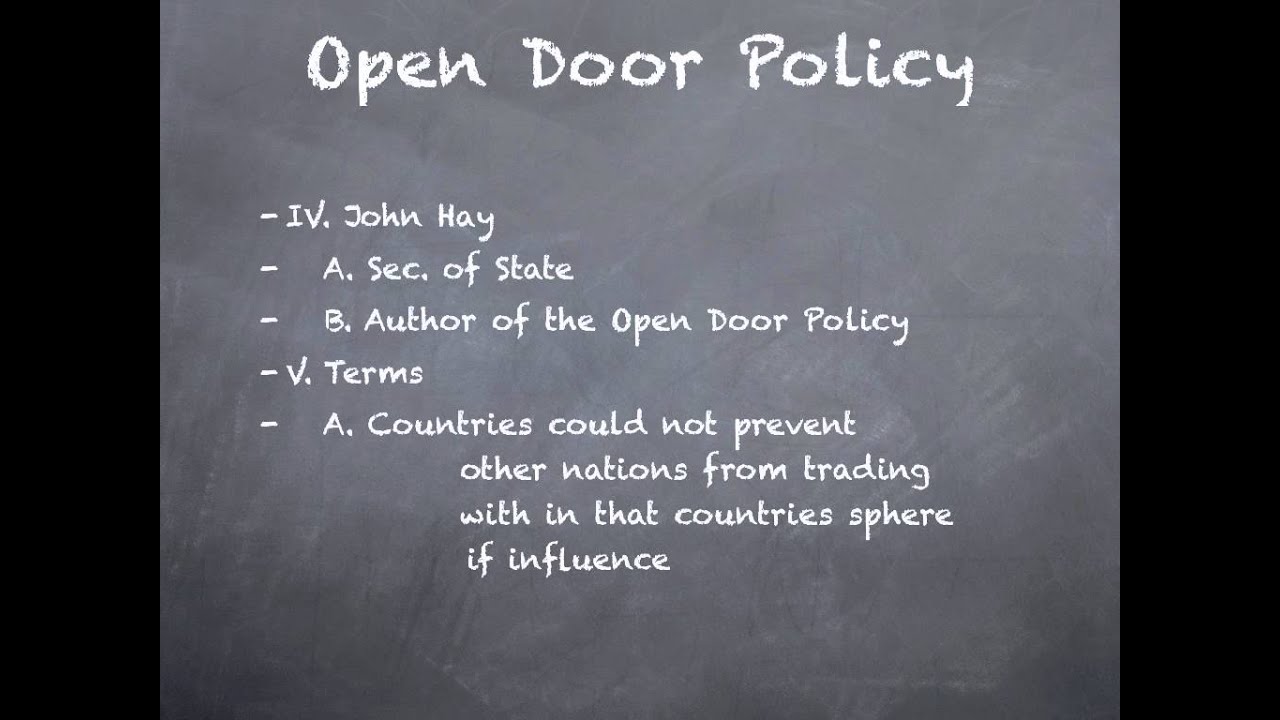
The core message of these notes was surprisingly simple: equal access. He proposed that all countries should be allowed to trade fairly in all parts of China. No special tariffs or exclusive rights for one nation in their claimed "sphere" should exist.
The Open Door Policy was a diplomatic plea: "Let everyone trade fairly in China, and let China remain one whole country."
What an "Open Door" Really Meant
This bold policy boiled down to a few fundamental, yet powerful, ideas. First, it declared that all countries should have equal access to trade with China, ensuring fair competition. No single nation should create a monopoly or offer special discounts only to its own businesses within its sphere of influence.
Second, and perhaps most refreshingly, the Open Door Policy also emphasized respecting China's territorial integrity and sovereignty. This meant that while everyone could trade, China itself was to remain a whole, independent country, not to be carved up politically or colonized outright.
Imagine a bustling antique shop filled with treasures. Each major power had claimed a display cabinet, putting up signs saying, "Only British customers here!" or "Japanese merchants get a special discount!" John Hay's policy was like saying, "Hold on! This is one shop, and everyone can browse and buy from any cabinet, and the shop owner (China) still runs the whole place!"
More Than Just a Door: A Diplomatic Twist
Of course, there wasn't an actual, physical "open door" that everyone simply walked through. This was a grand concept, a guiding diplomatic principle for how nations should interact. Yet, it was a huge step in international relations, advocating for free trade and preventing one country from completely dominating another's economy.
/Putting_his_foot_down-51a8e9c841f346eaa8d0d47b6588de33.jpg)
The policy was truly surprising because many expected the US, being a rising power, to simply grab its own "sphere" like all the others. Instead, Hay championed a policy that, on paper, benefited all trading nations equally and, crucially, protected China from being completely parceled out.
Here's the heartwarming twist: while its primary aim was undeniably to ensure American businesses weren't locked out, the Open Door Policy arguably helped prevent China from being fully colonized and dismantled. It offered a glimmer of hope that a powerful nation's territorial integrity could be maintained, even amidst intense foreign interest, showcasing a smarter way than just brute force.
The Echoes of an Open Door
The Open Door Policy wasn't a magic wand that instantly solved all of China's problems; history is never that simple. However, it definitely set an important precedent for international behavior and became a cornerstone of American foreign policy in Asia for decades to come.
It shaped how the United States viewed its role in global trade and emphasized the importance of equal access and respect for national sovereignty. This diplomatic principle, born from a desire for fair trade, offered a more hopeful vision for international engagement than outright territorial grabs.
Even today, the spirit of the Open Door Policy resonates when we talk about fair access to global markets or maintaining the integrity of nations. It's a reminder that diplomatic ingenuity can sometimes find solutions that seem to benefit everyone, even if born from self-interest.
Next Time You Hear "Open Door"...
Think beyond a literal door swinging open. Think of it as a brilliantly clever diplomatic maneuver, a plea for fair play in a cutthroat world, and a surprisingly protective measure for a vast and ancient land. It reminds us that sometimes, the simplest ideas, like just keeping a door open for everyone, can have the most profound and unexpected impacts on history.
It’s a fun little reminder that even in serious history and government, there's always a story of human ingenuity and, occasionally, a dash of unexpected fairness that changes the game. Who knew a bunch of letters could be so powerful?