
He Who Loves Not Abides In Death
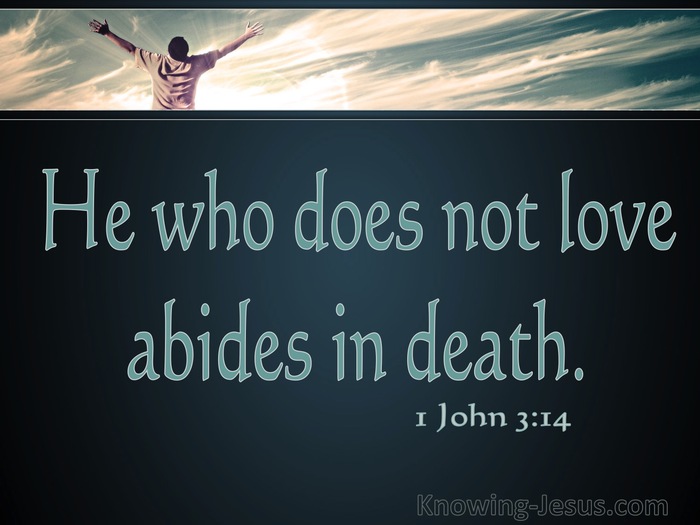
So, I was at my cousin Sarah's wedding last weekend. Lovely affair, really. Lots of sunshine, slightly too much mediocre prosecco, and enough questionable dance moves to power a small nation. Anyway, during the speeches, her new husband, bless his earnest heart, delivered a rather… intense toast. He was going on about how their love was a beacon, a guiding light, a permanent fixture in the cosmic tapestry. And then, he dropped this gem: "For he who loves not, abides in death."
My first thought? "Whoa, deep, dude." My second thought? "Did he just quote the Bible at his own wedding?" (He did, by the way. From the first epistle of John. Apparently, it's a pretty significant verse for them. Good to know.)
But you know, even though it sounds a bit dramatic, like something out of a gothic novel or a really intense self-help seminar, it really stuck with me. This idea of "abiding in death" not being about, you know, actual death. Because let's be honest, the dead don't really abide anywhere, do they? They're… gone. Absent. Not exactly known for their lease agreements.
So, what does it really mean to live a life that, by this rather stark definition, is essentially a form of spiritual expiration? And more importantly, how do we, in our everyday, messy, often un-biblical lives, avoid it? (Because let's face it, we're all probably guilty of a little bit of "abiding in death" at various points, right? Don't lie to me.)
The Opposite of Love? It's Not Exactly Hate, Is It?
When you hear "he who loves not," your brain immediately jumps to the opposite of love. And most of us would probably say, "Hate." Easy peasy. But is it, though? Think about it. Hate is an active emotion. It requires energy. You have to think about the thing you hate. You have to fuel that fire, in a way. It’s a very… engaged state of being.
And then there's indifference. Ah, indifference. That quiet, creeping sensation that can slowly drain the color out of everything. Indifference isn't fiery; it's… lukewarm. It's the beige of human emotions. It’s the feeling you get when you realize you forgot to set your alarm for the third time this week and you just sigh and accept your fate. Or when you scroll past a news headline about something awful happening thousands of miles away and think, "Well, that's sad. Anyway, what's for lunch?"
Indifference, my friends, is where I suspect a lot of this "abiding in death" business happens. It's not the dramatic plunge into hellfire; it's more of a slow, comfortable fade. It's the absence of feeling. And if love is, at its core, a profound feeling of connection, of care, of being deeply invested in something or someone else, then what is its absence? It’s not the loud roar of hate; it’s the chilling silence of… nothing.
Consider it this way: a seed that doesn't get watered, that doesn't get sunlight, doesn't exactly sprout into a magnificent oak. It just… withers. It doesn't fight. It doesn't rage against the dying of the light. It just… ceases to be. And isn't that a kind of death? A subtle, unacknowledged one?

So, if "he who loves not" is the one who "abides in death," then maybe it’s not about the grand gestures of passionate love versus the burning fires of animosity. Maybe it’s about the lack of engagement, the lack of care, the lack of seeing the world and the people in it as something worth investing in.
The "Death" of Connection
Let's talk about connection for a second. We're all wired for it, aren't we? From the moment we're born, we crave it. That primal need to be seen, to be heard, to be held. And as we grow, that need evolves. We seek out friendships, romantic partnerships, community. We want to feel like we belong, like we matter to someone other than our dog (though, let's be honest, our dogs are pretty important to us).
When we stop loving, or more accurately, when we stop cultivating love, we start to sever these connections. It’s not always a dramatic breakup or a shouting match. Sometimes it’s just… drifting apart. You stop calling your old friends. You stop checking in on your family. You become so absorbed in your own little bubble that the outside world, and the people in it, become blurry, indistinct figures.
And what happens when those connections fray? We become isolated. And isolation, my friends, can feel an awful lot like death. Not the physical kind, of course, but the death of our spirit. We stop being a part of something bigger than ourselves. We lose that sense of shared experience, of mutual support, of knowing that someone has your back.
Think about those people who seem perpetually grumpy or cynical. Are they actively hating everyone? Or are they simply… disconnected? Have they built up walls so high that no love can possibly get through, and no love can escape? It’s a self-imposed exile, isn't it? A quiet corner where joy and vibrancy go to die a slow, quiet death.

And it’s a vicious cycle. When you feel disconnected, it’s harder to muster the energy to love. It requires effort, doesn’t it? To reach out, to be vulnerable, to care when you might get hurt. So, you retreat. And the more you retreat, the more disconnected you become. It’s a downward spiral, a slow descent into… well, you know.
The Daily Grind and the Love Drought
Now, I'm not saying we all need to be some kind of saccharine, perpetually effervescent beacons of love. Let's be real. Life is hard. We have jobs we might not love, bills to pay, traffic jams that could make Gandhi question his non-violence. It’s easy for the demands of the daily grind to suck the love right out of us.
We get tired. We get stressed. We get… jaded. And in those moments, it’s easier to retreat into ourselves, to become a little bit more focused on our own survival, our own comfort, than on extending ourselves to others.
And that's okay. Acknowledging that is the first step, right? It’s not about perfection; it’s about intention. It’s about making a conscious effort, even when you’re bone-tired and feeling a bit sorry for yourself, to not let that indifference take root.
It's about the small things. A genuine smile to the barista. A moment of patience with a slow-moving shopper. A quick text to a friend just to say, "Thinking of you." These aren’t grand romantic gestures. They’re tiny sparks of connection. They’re the seeds of love that, when nurtured, can prevent the withering.
Because if we only reserve our love for the "big" moments – the weddings, the anniversaries, the grand declarations – then we're leaving vast stretches of our lives to the barren wasteland of "abiding in death." We're living in a spiritual desert, waiting for a miraculous rain that may never come.
And let's not forget the self-love aspect. This whole "love not" thing. Are we loving ourselves enough to even have anything left to give? If we're constantly running on empty, depleted, and full of self-criticism, how can we possibly radiate anything positive outwards? It's like trying to pour from an empty cup. Impossible, and frankly, a bit sad.
So, maybe the first "loves not" we need to address is the one directed inwards. Are we being kind to ourselves? Are we forgiving ourselves for our mistakes? Are we acknowledging our own worth, independent of external validation? Because if we can't even extend that basic kindness to ourselves, how can we expect to truly love anyone else, or to receive love in return?
The Ironic Beauty of the "Living Dead"
There's a strange irony, isn't there, in the concept of the "living dead"? People who are physically alive but emotionally numb, disconnected, and lacking in that vital spark of love. They’re the ones who go through the motions, who exist but don’t truly live. They're the ghosts in their own lives, haunting the edges of what could be.
And the funniest thing? They often don’t even realize it. They might complain about being lonely, about feeling unfulfilled, about the world being a cold, hard place. But they’re the ones who are actively choosing, through their inaction, through their refusal to engage with love, to create that very coldness.
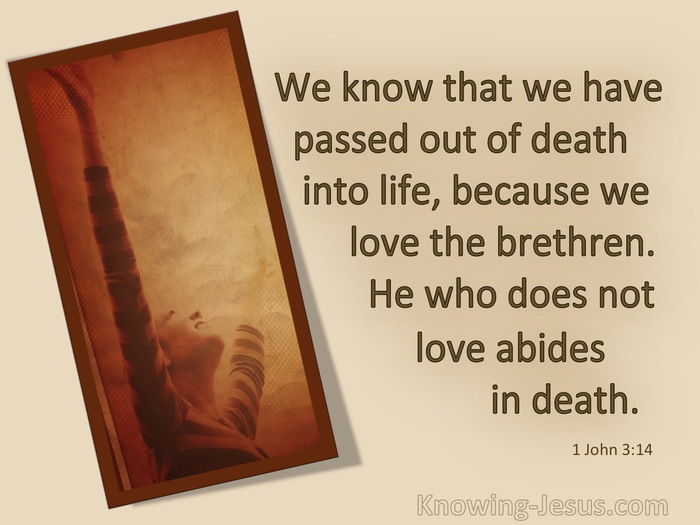
It’s like they're standing in a beautiful garden, with vibrant flowers blooming all around, and they’re complaining about the dust. They’re so busy being closed off that they’re missing the exquisite beauty that’s available to them. They are, in a very real sense, choosing to abide in a kind of death, a state of spiritual hibernation.
And the funny thing about "abiding" is that it implies staying put, remaining in a place. If you're abiding in death, you're not moving forward. You're not growing. You're not experiencing the messy, glorious, heartbreaking, and ultimately life-affirming journey of being truly alive.
It’s a choice, you see. A constant, ongoing choice. Do we choose to open ourselves up, even when it's scary? Do we choose to extend a hand, even when we might get burned? Do we choose to see the good, even when the bad feels overwhelming? Do we choose to love? Or do we choose to remain in the comfortable, familiar, and ultimately barren landscape of indifference?
Because, at the end of the day, that toast at Sarah's wedding, as dramatic as it was, holds a certain truth. It’s a reminder that a life devoid of love, a life where we’ve shut down our capacity for connection and care, is a life that, in a profound and significant way, is not truly living. It’s a life that, by its own definition, abides in a state of spiritual death. And who among us, if we’re being honest, hasn’t flirted with that idea from time to time?
So, let’s try to avoid the spiritual morgue, shall we? Let’s try to cultivate a little more love, in all its messy, imperfect, and glorious forms. Even if it’s just a quiet nod to the person walking their dog, or a moment of genuine appreciation for the sunrise. Because those tiny acts, those conscious choices to connect, are the very things that keep us alive, truly, vibrantly, and undeniably alive. And that, my friends, is a far more interesting place to abide.