
Big Stick Diplomacy: Definition And Examples

Ever heard someone say, "Speak softly and carry a big stick"? It's one of those classic quotes that just sounds cool, right? Like something a wise old action hero would say. But did you know this isn't just a catchy phrase? It's the core idea behind a fascinating chapter in history called Big Stick Diplomacy. And honestly, it’s a lot more interesting (and sometimes a little wild) than it sounds!
Imagine you're trying to get your friends to agree on where to go for pizza. You could shout, argue, or even stomp your foot (please don't). Or, you could calmly suggest your favorite place, perhaps mentioning that you happen to be the one with the car keys and the only person who knows how to navigate rush hour traffic. See? You're speaking softly, but everyone knows you've got a "big stick" – the power to get them there. That's the essence of it, but on a global scale!
What Exactly Is Big Stick Diplomacy?
At its heart, Big Stick Diplomacy is a foreign policy strategy where a country communicates its intentions peacefully, but always backs up its words with the implied (or sometimes very explicit) threat of military force. It’s about projecting power and influence without necessarily firing a single shot. The idea is to make sure everyone knows you’re strong and ready, so they’re more likely to listen to your "soft" words.
The famous line, "Speak softly and carry a big stick; you will go far," comes directly from the man who perfected this approach: President Theodore Roosevelt. Picture TR, a larger-than-life figure, bursting with energy, leading the United States onto the global stage in the early 20th century. He was a firm believer that the US needed to assert itself, especially in its own backyard (meaning, the Americas).
Theodore Roosevelt: The Man with the Stick
TR wasn't just a president; he was an adventurer, a Rough Rider, and a true force of nature. He believed in action and strength. For him, Big Stick Diplomacy wasn't about being a bully; it was about ensuring stability and protecting American interests. He wanted the US to be a respected global player, not just an isolated nation. And to do that, he felt the world needed to know that America wasn't to be trifled with.
Think of it like this: a friendly school principal. They usually speak calmly, explain the rules, and try to resolve conflicts peacefully. But everyone knows that if things get out of hand, they have the authority (the "big stick" of detention or suspension) to enforce order. That underlying power makes their soft words carry a lot more weight. TR applied this same psychology to international relations.

Why Was It Such a Big Deal? The Panama Canal!
Perhaps the most famous (and certainly most impactful) example of Big Stick Diplomacy in action is the creation of the Panama Canal. This was a massive undertaking, a dream centuries in the making: digging a shortcut through Central America to connect the Atlantic and Pacific Oceans. It would revolutionize global trade and military strategy.
The problem? The proposed canal zone was part of Colombia, and they weren't exactly keen on the US taking over. Negotiations stalled. What's a determined president to do? TR, ever the pragmatist, saw an opportunity. When Panamanian separatists decided they wanted independence from Colombia, Roosevelt subtly (or not so subtly, depending on your view) threw his support behind them.
American warships just happened to appear off the coast of Panama, effectively preventing Colombian troops from quashing the rebellion. Lo and behold, Panama gained independence almost overnight. And guess what one of the first things the new Panamanian government did? They signed a treaty with the US, granting them the rights to build and operate the canal.

Was it a direct use of force? Not exactly. Did those American warships act as a powerful "big stick" that influenced the outcome? Absolutely! It was a brilliant, if controversial, demonstration of speaking softly (through diplomatic support for Panamanian independence) while carrying a very big stick (a formidable navy). The canal got built, changing the world forever, all thanks to a bit of strategic stick-wielding.
Keeping Order: The Roosevelt Corollary
Another major flex of the "big stick" was the Roosevelt Corollary to the Monroe Doctrine. Okay, that sounds like a super boring history textbook title, but stay with me! The original Monroe Doctrine (from way back in 1823) basically told European powers to stay out of the Americas. "This is our neighborhood," it declared.
But by the early 1900s, some Latin American countries were struggling to pay debts to European nations. This often led to European powers threatening military intervention to collect what they were owed. TR saw this as a potential loophole, a way for those "outsiders" to muscle their way back into the Western Hemisphere.
So, TR came up with his Corollary. It essentially said, "Hey, if Latin American countries can't manage their own affairs and keep their finances in order, the U.S. might have to step in as an international police power." The idea was to prevent European intervention by taking on the responsibility (and the power) ourselves.
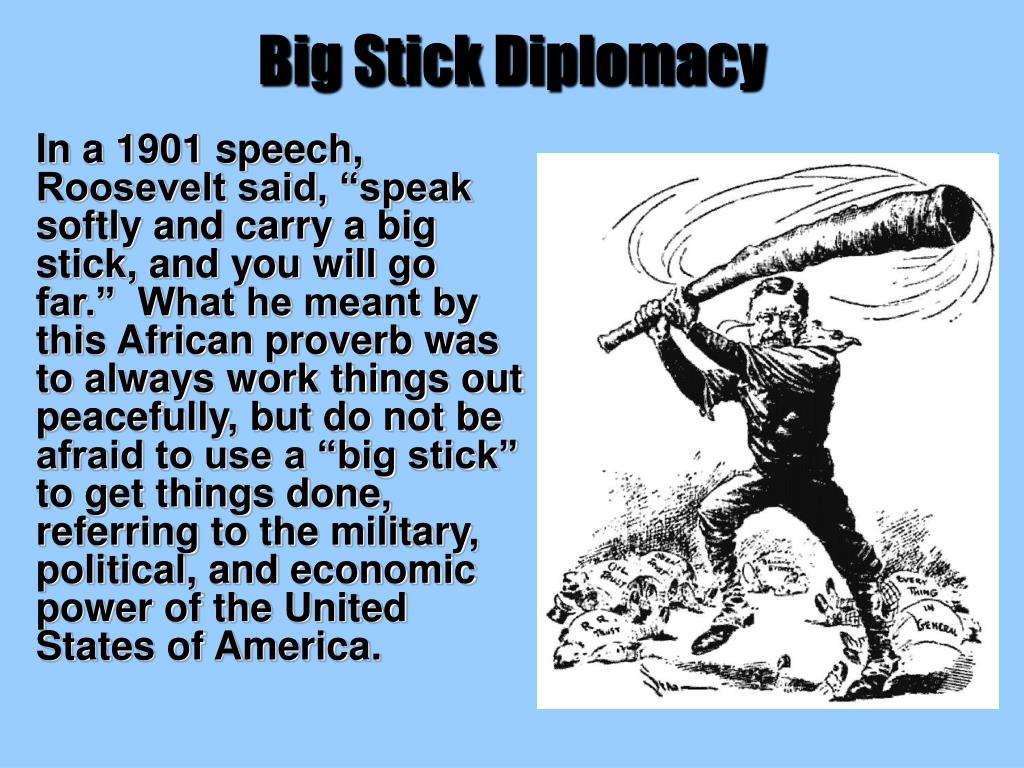
This was a massive expansion of American influence. Imagine being the oldest sibling in a house full of younger ones. You might say, "Look, if you guys can't keep your rooms clean, I'll clean them for you. And trust me, you won't like my method!" You're trying to keep the peace and prevent Mom and Dad from getting involved (the European powers), but you're doing it by showing your own strong hand. It was controversial then, and still is today, but it definitely showed the world that the US was serious about its regional dominance.
The Ultimate Flex: The Great White Fleet
Want another fun example of showing off the "big stick" without using it? Enter the Great White Fleet. In 1907, TR decided it was time for a little show-and-tell. He sent the entire US Atlantic Fleet – 16 gleaming white battleships – on a round-the-world cruise.
This wasn't about attacking anyone. It was a diplomatic mission to demonstrate American naval power to the world. Imagine someone driving their brand-new, super-powerful sports car slowly through your neighborhood, making sure everyone gets a good look. They're not racing, they're not causing trouble, but you definitely get the message: "I've got power."

The Great White Fleet was a truly spectacular sight, sailing into ports from South America to Asia, impressing millions. It was a testament to American shipbuilding, naval prowess, and global reach. It sent a clear message: the US was a force to be reckoned with, capable of projecting its power across oceans. This was Big Stick Diplomacy in its purest form: demonstrating capability without needing to deploy it in conflict.
The Coolness Factor and Lasting Impact
So, why is Big Stick Diplomacy "cool" or interesting? Well, it's a fascinating look at the psychology of power. It's about how the threat of force can be as effective, if not more effective, than actual force. It highlights the delicate dance between diplomacy and military might. It's also a testament to TR's audacious personality and his vision for America's role in the world.
While the phrase "Big Stick Diplomacy" faded after Roosevelt, the underlying principle – backing up diplomatic initiatives with a strong military – has remained a staple of foreign policy for many nations, including the US. It teaches us that sometimes, the loudest message is delivered not through shouting, but through a calm voice accompanied by undeniable strength.
It wasn't always perfect, and it certainly had its critics and caused some resentment, particularly in Latin America. But there’s no denying that Theodore Roosevelt’s Big Stick Diplomacy profoundly shaped early 20th-century international relations and carved out a significant role for the United States on the global stage. It’s a powerful reminder that history is full of clever strategies and larger-than-life characters!