
Analysis Of Dulce Et Decorum Est Poem

Ever stumbled upon a poem that just grabs you? Like, really makes you feel something? That's what I'm talking about when I think about Dulce et Decorum Est. It's not your average "roses are red" kind of poem. Nope, this one's a bit of a wild ride, but in the best way possible.
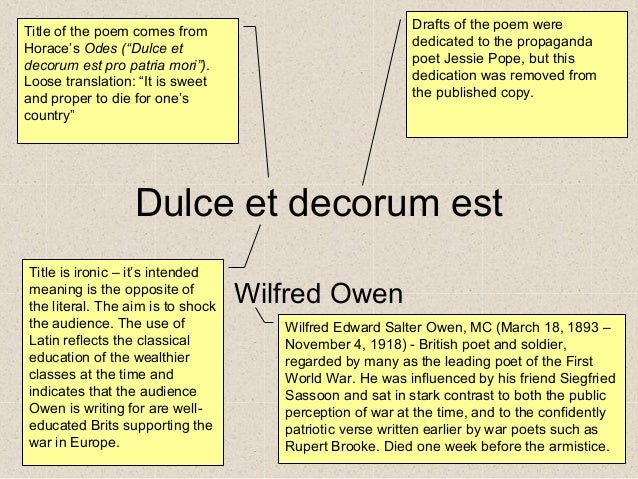
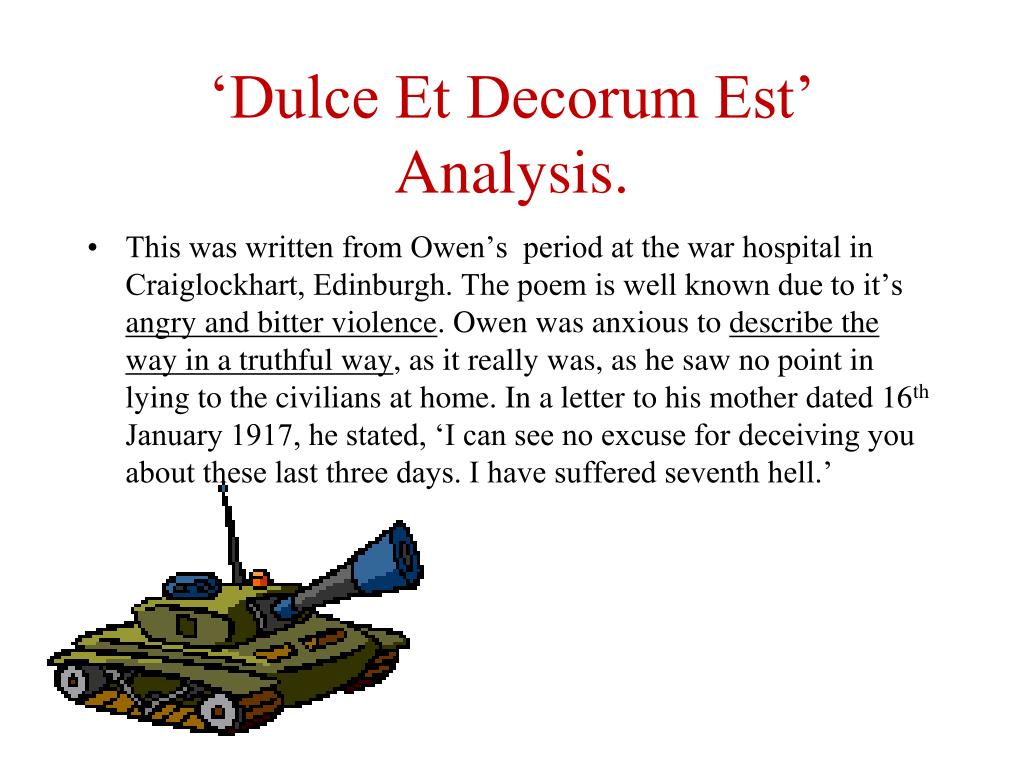
Written by Wilfred Owen, this poem drops you right into the thick of things. We're talking World War I here, and it's not sugar-coated. Owen was a soldier himself, so he knew exactly what he was talking about. He wasn't afraid to show the messy, the scary, the downright awful parts of war.
Think of it like this: you're watching a movie, and suddenly it cuts to a really intense, no-holds-barred scene. That's kind of what reading this poem feels like. It’s meant to wake you up and make you think. And honestly? It totally succeeds.
The title itself, Dulce et Decorum Est, is a bit of a wink and a nudge. It's Latin, and it basically means "It is sweet and fitting." Sweet and fitting to do what, you ask? Well, that’s where the poem gets really interesting. It challenges a very old, very traditional idea.
For ages, people thought fighting and dying for your country was the noblest thing you could do. Like, the ultimate heroic act. Owen takes that idea and gives it a good, hard shake. He's like, "Hold on a second, is it really sweet and fitting when you see what actually happens?"
He paints a picture of soldiers so exhausted they can barely stand. They're trudging along, absolutely knackered, covered in mud and grime. It's not glamorous. It's gritty and real.
Then comes the terrifying part. Out of nowhere, there's this sudden attack. Gas! The soldiers have to scramble, put on their masks, but one poor guy doesn't make it in time. This is where the poem really hits you.
Owen describes the dying soldier in vivid detail. It's not a heroic death. It's painful and ugly. He talks about the sound of him choking, the "froth-corrupted lungs." Yeah, it’s not pretty, but that's the point.
He wants you to imagine it. He uses words that make you feel like you're there, smelling the gas, hearing the sounds. It’s an assault on your senses, in a way that sticks with you.
And then, the big reveal. Owen turns back to that Latin phrase. He says, "My friend, you would not tell with such high zest / To children ardent for some desperate glory, / The old Lie: Dulce et decorum est / Pro patria mori."
He's basically calling out anyone who still believes that dying for your country is this glorious, wonderful thing, especially when you tell it to young people who are eager for adventure and glory. He calls it "The old Lie." Bold stuff, right?
What makes Dulce et Decorum Est so special is its honesty. It doesn't shy away from the truth. It’s a powerful anti-war poem, but it’s not preachy. It’s a personal account, told with raw emotion.
Think about how many poems are about love or nature. They're beautiful, no doubt. But this poem? It's about the harsh realities of life and the cost of conflict. It’s a conversation starter, for sure.
The way Owen uses language is just masterful. He uses similes and metaphors that are incredibly effective. He compares the soldiers to "old beggars," which is a stark image of their brokenness.
And the pacing! The poem builds up tension so effectively. You feel the dread creeping in, and then BAM! The attack. It’s like a rollercoaster of emotions, but a really important, thought-provoking one.
It’s the kind of poem that makes you pause and reflect. It makes you question things you might have taken for granted. It’s a wake-up call to the true cost of war.
Many poems might describe the glory of battle. But Owen shows the grim aftermath. He doesn't want to glorify war; he wants to expose its brutal reality.
When you read it, you can almost feel the fear and the desperation of those soldiers. You understand why Owen felt compelled to write it.
It's entertaining not because it's fun, but because it's so incredibly real. It’s like looking through a window into a past that’s both horrifying and profoundly human.
It challenges you. It makes you uncomfortable, and that’s often where the most important learning happens.
The poem's enduring power comes from its unflinching gaze at suffering. It forces readers to confront the grim consequences of war.
It's a stark reminder that "glory" often comes at a terrible price. A price paid by individuals, not abstract nations.
So, if you're looking for something that will truly make you think and feel, something that’s both a historical document and a work of art, give Dulce et Decorum Est a read. It might be intense, but it's an experience you won't forget.
It’s a poem that speaks truth to power, or rather, truth to outdated notions of honor and sacrifice.
Owen’s voice is so strong and clear, even after all these years. You can hear his outrage, his sorrow, and his desperate plea for understanding.
It’s a poem that has stayed with people for generations, and for good reason. It’s a testament to the power of poetry to bear witness and to challenge the status quo.

It’s not always easy to read, but sometimes the most important things aren't.
And that, my friends, is why Dulce et Decorum Est is such a remarkable piece of writing. It’s a poem that dares to speak the unspeakable, and in doing so, it leaves an indelible mark.
It’s a poem that reminds us that behind every great war, there are individual lives, individual suffering, and individual truths that deserve to be heard.
So next time you’re looking for something that’s more than just words on a page, consider this powerful piece by Wilfred Owen. You might just find yourself utterly captivated.
It's a powerful piece of literature that continues to resonate today.
It’s a poem that has a way of lodging itself in your mind and heart, long after you’ve finished reading it.